How Plant Germination Became a Sequence We Can Describe
Plant germination becomes easier to understand when you can distinguish water uptake, root emergence, and the first leaves from guesses about hidden growth.
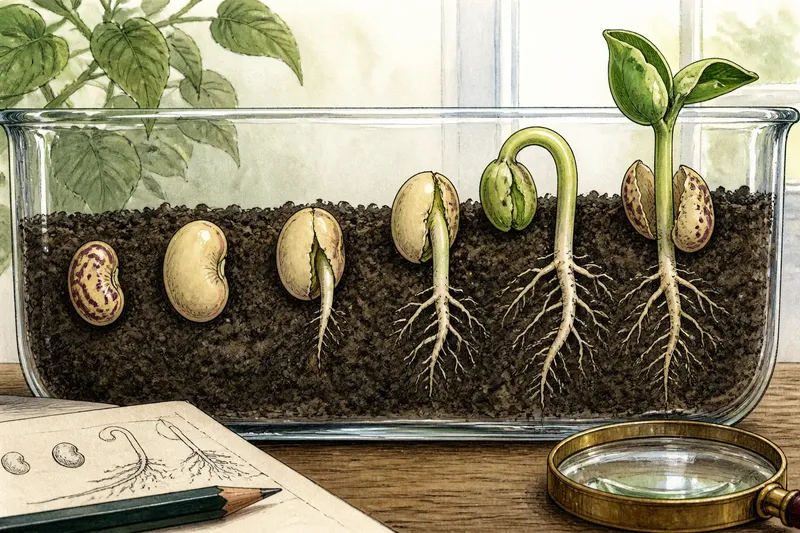
How do we know what a seed is doing before a shoot appears? Plant germination is easier to describe when its visible stages are separated from explanations of what happens inside the seed. That distinction also gives the history of germination a firmer footing: people could observe swelling, a split coat, and an emerging root long before they could see the embryo at work.
Plant germination starts with changes that can be seen
A dry seed may look unchanged while it takes up water and swells. The embryo, a young plant already present inside the seed, begins growing again under suitable conditions. Germination names this resumption of growth; it does not mean that a plant appears from soil or from nothing.
For much of natural history, observers had to infer the hidden parts of this process from what emerged. A seed planted in opaque soil concealed its early changes. The sequence became easier to describe when seeds were compared at different stages, or when a transparent vessel exposed the coat and the first root. Those observations support claims about visible order, not every cause of growth.
This is the most defensible historical thread: better opportunities to observe seeds helped make descriptions more specific. Without dated records or named observers, it would be misleading to claim a single turning point or a tidy march from confusion to modern botany.
Comparing seeds made the stages clearer
Repeated observations can distinguish a sequence from a single impression. A seed may swell, split its coat, send out a root, and later produce a shoot. Naming these stages helps readers compare what they see without assuming that all seeds follow the same visible pattern.
Beans make the sequence easy to recognize, but they are not a universal model. In a bean, the first root-like structure, called the radicle, commonly grows downward. The shoot extends upward, and the seed leaves may rise above the soil. Other species can differ in the order or position of these parts; some keep their cotyledons, or seed leaves, below ground.
That comparison changed the quality of description more than it settled every question. An observer can report that a root appeared before a shoot. Explaining why it grew in a particular direction requires more than noting the order.
The first root marks a change in the seedling
The radicle is often the first part to emerge. It extends into the surrounding soil, anchors the young plant, and takes up water and dissolved materials. Its early appearance is a useful sign that growth has advanced beyond swelling alone.
A root and a shoot respond to different surroundings and perform different jobs. The root grows into the soil; the shoot heads toward the surface. Seeing both structures makes the seedling’s development easier to describe, but a root’s appearance by itself does not tell an observer how well the plant will continue to grow.
The shoot and seed leaves reveal the next stage
After the root emerges, a shoot may push upward. In a bean, it can appear as a curved hook that protects the growing tip as it passes through soil. Once above the surface, it straightens, and the cotyledons may open.
Cotyledons were formed within the seed and can supply stored nourishment as the seedling establishes itself. They may look unlike the later leaves. Identifying them prevents a common misreading: the first green parts are not always miniature versions of the plant’s mature foliage.
What can visible germination tell you?
Does a swollen seed mean it has germinated successfully?
Swelling shows that the seed has taken up water. It does not establish that the embryo will continue growing or that a healthy seedling will emerge.
Why might the root appear before the shoot?
The emerging root can anchor the seedling and begin taking up water as growth resumes. The sequence varies among plants, so a bean’s pattern should not be treated as a rule for every seed.
Are the first leaves the plant’s regular leaves?
They may be cotyledons, or seed leaves, which formed inside the seed. Their shape can differ from the later leaves that develop as the plant grows.
Can a seed begin germinating without light?
Some seeds can begin germination without light, while light affects the germination or emergence of others. The answer depends on the plant and its surroundings.
A simple record keeps the historical question honest
Imagine a reader places a bean seed against the glass of a jar containing damp soil. At the start, the coat is intact and the seed is dry. The reader adds water to moisten the soil, then records the visible change each time the jar is checked: first swelling, then a split coat, then a pale root, followed by a curved shoot and opening seed leaves. The resulting record supports a clear answer about sequence: in this seed, swelling came before root emergence, and root emergence came before the visible shoot. It does not establish why every bean behaves that way, or how every plant germinates.
For a useful observation, check each feature and let the result guide the next action:
- If the seed coat is intact and the seed remains dry, note that no swelling is visible; if it has begun to swell, record the change without calling it a successful seedling.
- If the coat has split, record the opening; if it remains closed, keep the observation neutral rather than inferring that the seed is dead.
- If a distinct root is visible, identify it as the radicle; if a pale mark could be soil or a root, wait for a clearer shape instead of assigning it a role.
- If the root extends into the soil, note its direction; if the container’s view is obscured, shift the angle or use a clearer viewing position rather than digging up the seed.
- If a curved shoot appears, record it as a shoot; if no shoot is visible yet, continue noting the seed’s condition without treating the pause as a conclusion.
- If the first leaves resemble seed leaves, record them as possible cotyledons; if their identity is unclear, wait for later leaves before naming them.
- If the plant is being grown for planting rather than observation, follow the seed packet or grower’s instructions; if the aim is simply to watch, choose a transparent container that avoids disturbing the seed.
It is not worth assigning a dramatic meaning to every small change in color or shape. Soil can cling to a seed coat, and a pale mark may be hard to identify through glass. A clear change in structure is more useful than an elaborate explanation built on an uncertain view.
Plant germination is now described through a vocabulary of stages and structures, but the sound habit behind that vocabulary is older and simpler: state what appeared, in what order, and where the limits of the observation lie. Keep the seed’s identity attached to the record. A sequence that describes a bean accurately is useful; it does not need to pretend to speak for every seed.