The Hidden Work of a Leaf: How Plants Exchange Water and Air
How leaves exchange water and air: learn what stomata regulate, why pores open and close, and how the balance supports a plant through changing conditions.
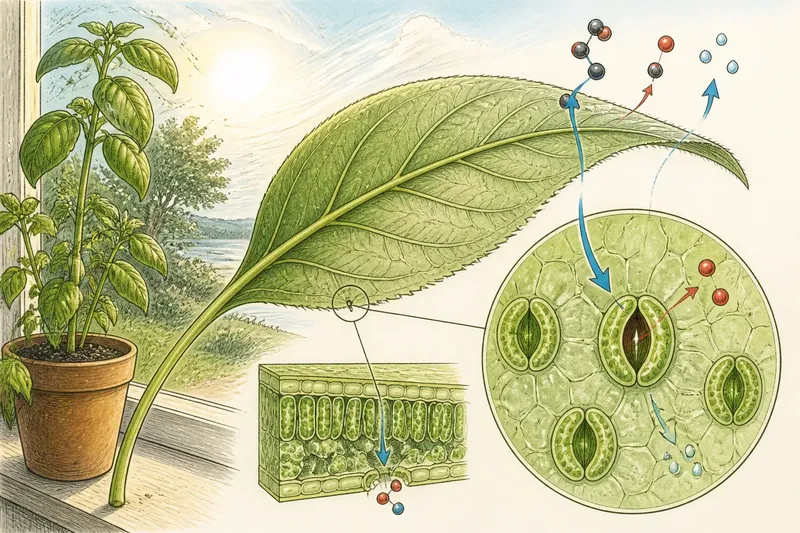
How do leaves take in carbon dioxide without losing too much water? They use tiny adjustable pores, mostly on the leaf’s underside, to trade gases with the air while limiting the water vapor that escapes. These pores, called stomata, make a leaf less like a sealed panel and more like a door with a careful doorman.
What are stomata, and where are they found?
Stomata are microscopic openings in the leaf surface. Each opening is bordered by two guard cells, which change shape to widen or narrow the pore. A leaf may have many stomata, but their number and placement vary among plant species and can differ between the upper and lower surfaces.
In many familiar garden plants, most stomata sit on the underside. That position can reduce direct exposure to sun and moving air, both of which can speed water loss. Other plants have stomata on both surfaces, and some leaves have surface features such as hairs or a waxy coating that affect the air around the pores.
Stomata are not little lungs that pump air in and out. Gases move mainly by diffusion: molecules travel from areas where they are more concentrated toward areas where they are less concentrated. The pore’s size influences how readily that exchange happens.
How does a leaf take in carbon dioxide?
Carbon dioxide enters through open stomata and moves through spaces inside the leaf to reach photosynthetic cells. Those cells use carbon dioxide, water and light energy to make sugars. Oxygen is produced in the process and can diffuse out through the same pores.
The exchange is not a one-way transaction. While a leaf can be taking in carbon dioxide and releasing oxygen, water vapor is also escaping from moist internal surfaces into the air. A pore that allows useful carbon dioxide to enter also provides an exit route for water vapor.
This is why a leaf cannot simply leave every pore open at all times. Keeping stomata open can support photosynthesis when light is available, but it also exposes the leaf’s internal moisture to the surrounding air. Closing them conserves water, while restricting carbon dioxide entry.
Why does water leave through open pores?
Water evaporates from damp surfaces inside a leaf and then diffuses out through stomata. This loss of water vapor is called transpiration. It can continue as long as the leaf’s internal air spaces are more humid than the air outside and the pores remain open enough for vapor to escape.
Transpiration is connected to water movement through the whole plant. As water leaves a leaf, it can help draw more water upward through the plant’s water-conducting tissues, from roots toward stems and leaves. Water also supplies materials used in photosynthesis and helps keep cells firm.
But the effect depends on conditions. Dry air, warm temperatures, strong sunlight and moving air can increase the demand for water at the leaf surface. If roots cannot replace water as quickly as it leaves, the plant may lose turgor, the pressure that helps keep soft tissues upright. A drooping leaf is visible evidence that water balance is under strain, though drooping can have other causes too.
How do guard cells open and close a pore?
Guard cells respond to internal signals and environmental conditions by changing their water content. When they take up water, they become more turgid and bend in ways that open the pore between them. When they lose water, the cells relax and the opening narrows or closes.
Light often favors opening because photosynthesis can use incoming carbon dioxide. The plant’s water status also matters: signals associated with drought can prompt guard cells to close stomata, reducing water loss. These responses are not a simple switch controlled by one cue. Light, humidity, temperature, carbon dioxide levels and the plant’s condition can all contribute.
Closure limits transpiration, but it also restricts the supply of carbon dioxide. The plant is balancing competing needs rather than choosing a perfect setting. Its response can differ over the day, across seasons and between leaves on the same plant.
Why can’t stomata stay open all day?
Open stomata can help a leaf gather carbon dioxide for photosynthesis, but prolonged opening may drain water faster than the plant can replace it. Closing stomata reduces that loss, yet a longer closure also limits photosynthesis. The balance shifts with the conditions around the leaf and the water available to the roots.
Imagine a potted basil plant on a bright, breezy windowsill. If its potting mix has become dry, the plant may narrow its stomata to conserve water; the observable result may be less water vapor leaving the leaves, alongside reduced access to carbon dioxide. If the mix is moist and the air is less demanding, the plant may keep pores more open. The example illustrates a trade-off, not a universal schedule: basil’s response depends on its condition and surroundings.
Plants adapted to dry environments often limit water loss in different ways, such as having small leaves, thick coatings or stomata that are recessed below the surface. Some plants open stomata mainly at night, when cooler conditions may reduce water loss, and use a different pattern of carbon fixation. These adaptations alter the timing or cost of exchange; they do not eliminate the need to obtain carbon dioxide.
What can you observe without a microscope?
Stomata themselves are usually too small to see clearly without magnification, but you can notice conditions that influence their work. Compare a plant in calm shade with one in a sunny, windy spot, or observe how a soft-leaved plant changes as its potting mix dries. Such comparisons cannot reveal pore size directly, but they can make the surrounding conditions easier to connect with leaf behavior.
For a closer look, a handheld microscope may show stomata in a thin leaf surface or a clear impression made with a suitable leaf-imprint method. Choose a leaf you can examine without harming a rare or protected plant. A view of stomata shows their arrangement, not whether they are open at that moment; pore width and guard-cell shape are the relevant details.
It is not worth trying to infer a plant’s water status from one leaf in isolation. Older leaves, pests, root trouble and ordinary daily variation can all affect appearance. Look at several leaves and consider the soil and recent weather before drawing a conclusion.
Which questions about leaf pores come up most often?
Do all plants have stomata on the underside of their leaves?
No. Many plants concentrate stomata on the lower surface, but some have them on both sides, and their distribution varies by species. A leaf’s visible surface alone does not tell you the full arrangement.
Do stomata release oxygen?
Oxygen produced during photosynthesis can diffuse out through open stomata. The same pores also allow carbon dioxide to enter and water vapor to leave, so they serve several exchanges at once.
Can a plant close its stomata completely?
Stomata can narrow substantially or close in response to conditions such as water stress. The degree and timing vary, and a closed pore reduces gas exchange as well as water loss.
Does a drooping leaf mean the stomata are closed?
Not necessarily. Drooping can accompany water shortage and stomatal closure, but it can also result from other stresses or damage. The leaf’s appearance is a clue to investigate, not a direct reading of pore activity.
Why does this exchange matter beyond a single leaf?
Stomata connect a plant’s internal processes to its surroundings. Their openings affect carbon dioxide supply for photosynthesis, water movement through the plant and the moisture released into the air. A leaf’s response therefore reflects a practical compromise: gather the materials needed to grow while retaining enough water to keep tissues functioning.
When you look at a leaf, its smooth surface hides that negotiation. The pores are small, but their work links sunlight, air, water in the soil and the plant’s capacity to keep growing. The useful detail to remember is that a leaf’s gas exchange and water loss are not separate jobs; they share the same adjustable openings.