Why Food Chains Miss the Web of Predator and Prey
Food chains miss the web of predator and prey: trace overlapping feeding links in a familiar habitat and separate direct observations from plausible guesses.
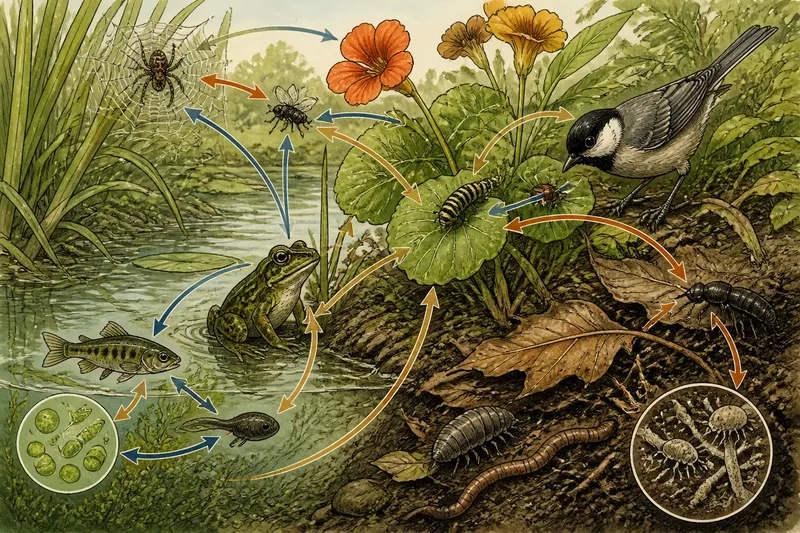
Why does a predator rarely belong to just one food chain? Food chains miss the web of predator and prey because several hunters may share a food source, while one hunter may feed on different prey at different times. A small patch of habitat makes those overlapping links easier to observe without turning every sighting into a claim about what an animal ate.
A food chain simplifies a habitat rather than mapping it
A chain might run from grass to a grasshopper to a frog to a heron. It gives a clear route for following energy through feeding relationships, but it makes the scene look more orderly than it is. A frog may eat several kinds of invertebrate, and a heron may take fish, frogs, or other available prey. The grasshopper, meanwhile, can feed more than one predator.
A food web puts these connections together. Producers, such as grasses and algae, capture energy; consumers feed on plants or other animals; decomposers break down dead material. Arrows usually point from the food toward the organism eating it, showing the direction energy moves. A web does not show every interaction. It displays selected feeding links without pretending they form a single line.
The distinction matters because a change affecting one food source can touch several consumers. If a pond insect is eaten by fish, frogs, and birds, its role is not confined to one chain. That does not mean every change causes a dramatic cascade. It means the local menu has overlapping entries, and the effects depend on which organisms use them.
Build the web around one patch of habitat
Choose a place small enough to observe repeatedly: a pond edge, meadow corner, woodland log, or garden bed. Keep the boundary steady. Starting with an entire park tends to turn the exercise into a census of everything you have ever heard of, which is not especially useful for noticing relationships.
Use a field notebook or a simple paper diagram. Record the place, conditions you noticed, and what each organism was doing. “Small brown beetle under leaf litter” is more useful than a confident species name that may be wrong. Keep direct observations separate from possible feeding links.
- Check which plants and other producers are present; if you can identify them reliably, list them, and if not, describe their visible features without guessing a name.
- Check for animals feeding, carrying prey, or investigating food; if you see feeding clearly, record the food and consumer, and if the behavior is ambiguous, note the behavior without drawing a link.
- Check for chewed leaves, web strands, seed husks, and tracks; if a sign identifies a likely source clearly, record the supported inference, and if it does not, leave the culprit open.
- Check each proposed arrow against what you observed; if the feeding link was direct, mark it as observed, and if it is only plausible, label it uncertain or leave it off the confirmed web.
- Check the habitat boundary and date on each visit; if they stayed consistent, compare observations, and if they changed, separate the records rather than treating them as one patch.
- Check whether an uncertain link matters to the question you are asking; if it does, plan a quiet follow-up observation, and if it does not, leave it unresolved instead of adding a speculative arrow.
Say you visit a garden bed and see a caterpillar on a nasturtium leaf, then later notice a bird searching among the plants. Record the leaf feeding as a direct observation and the bird’s search as behavior, but do not draw an arrow from that caterpillar to that bird unless you see the bird take it. The resulting diagram has one clear feeding link and one open question, rather than a tidy chain assembled from guesses.
Use repeated visits to separate evidence from assumption
A short routine helps reveal how much one visit can miss. The aim is not to produce a complete web; it is to add links carefully and notice where the picture changes.
- Set the boundary: On the first visit, choose a consistent patch and list the organisms and signs you can identify. Sketch possible links in pencil, but do not treat them as facts.
- Look for direct feeding: On a later visit, note what is being eaten, where it happens, and whether the observation is clear enough to support an arrow.
- Vary the viewing conditions: Return at another time of day or after a change in weather, if convenient. Check whether the same organisms are active and whether fresh signs appear; one quiet visit does not establish that an organism is absent.
- Review uncertain links: Seek another observation, a field-guide clue, or a cautious label such as “possible prey.” Keep evidence and inference visually distinct.
- Redraw the web: Put confirmed links first and show uncertain connections differently. Note which organisms connect several parts of the diagram.
Use binoculars or a hand lens only when they help you observe without disturbing the habitat. A phone photo can help with later identification, but an animal near a plant is not evidence that it feeds on that plant. Do not move animals, dismantle shelter, or collect organisms to make the diagram more complete.
Not worth the effort: drawing an arrow for every possible meal listed in a general field guide. A local web is more informative when it distinguishes what happens in this patch from what an organism might eat elsewhere.
Read overlapping links without ranking every predator
Once several links are visible, look for shared prey and flexible diets. A prey species connected to several predators is one kind of overlap. A predator connected to several prey types is another. Some organisms occupy different roles at different life stages, and the same animal may feed differently as food availability changes. A web can show this variety; a one-line chain cannot.
Food webs have limits. They show feeding relationships, not every influence on survival. Shelter, competition, disease, weather, and timing can matter without appearing as arrows between eater and food. Nor does a web imply that every predator is equally important or that removing one organism would have a predictable result. It is a map of selected connections, not a control panel for nature.
When comparing visits, ask what changed in the evidence rather than demanding a complete explanation. A new predator sighting may reveal a connection, or it may simply reflect better visibility. A missing prey species may have moved, become inactive, or escaped notice. Keeping those possibilities open is part of describing a habitat honestly.
How can you read and check a food web?
Which way should food-web arrows point?
Point each arrow from the food organism toward the organism that consumes it. This convention shows the direction energy moves, not the direction a predator travels.
Does an animal belong to only one food chain?
No. An animal can eat several kinds of food and be prey for several predators, so its connections often cross multiple chains. Its role may also shift with life stage or local food availability.
Can a food web predict what happens if a species disappears?
It can help identify organisms that share a feeding connection, but it cannot by itself predict the result of a loss. Other food sources, behavior, and habitat conditions shape what follows.
How can you tell whether a feeding link is real?
Direct observation is the clearest evidence, while tracks, feeding marks, and remains can support a cautious interpretation. Label uncertain links as possible, and consult a field guide or local naturalist when identification matters; follow applicable site rules and species guidance.
Keep the diagram open to revision
A useful food web is allowed to look unfinished. Add a link when evidence supports it, revise an identification when better information becomes available, and leave gaps where the habitat has not answered your question. The diagram then becomes a record of overlapping feeding relationships in one particular place, not merely a schoolroom chain with extra arrows.
On your next visit, choose one uncertain connection and watch for it without disturbing the animals or their food. Write down what you actually see, including when you see nothing. The food chains miss the web of predator and prey most clearly when a tidy line hides several unconfirmed assumptions; leaving those gaps visible is useful information in its own right.