Moss or Lichen? A Close Look at Two Green Surfaces
Moss or lichen can look alike on stone and bark. Learn to read their texture, structure, and growth pattern without pulling either apart.
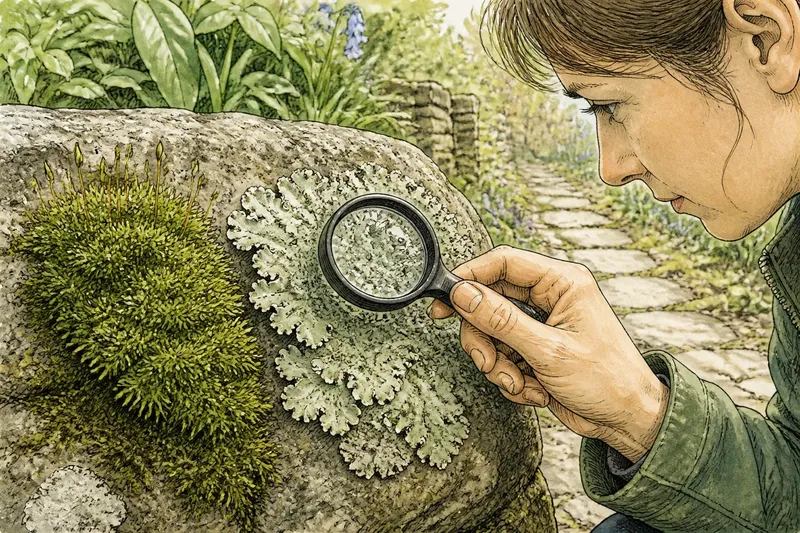
Moss or lichen: which green patch is spreading across the stone by the garden path? Start by looking closely rather than picking at it. Moss is a small plant with visible leafy shoots; lichen is a partnership between a fungus and an alga or cyanobacterium, usually forming a crust, flakes, or branching tufts. The distinction is often clear once you know where to direct your attention.
Begin with the shape of the patch
From a short distance, both can make a rock or tree trunk look green, gray, or soft. Move nearer and notice the outline. Moss commonly forms a cushion or mat made of many small upright or trailing shoots. The surface may look plush, with fine tips pointing in different directions.
Lichen more often appears as a flat crust, a collection of leaflike lobes, or narrow branches. A crustose lichen sits closely against its surface; a foliose one has flattened lobes with distinct edges; a fruticose one grows in tiny upright or hanging branches. These forms are useful clues, not labels to assign from color alone.
Moss or lichen is easier to identify by structure
Look for repeated miniature stems and leaves. Moss leaves are tiny, but a hand lens can reveal their orderly arrangement along shoots. A patch may contain many shoots of similar height, giving it a finely textured, almost miniature-forest appearance. Some mosses also have slender stalks topped by capsules, though these may not be present or visible.
Lichen has no true leaves, stems, or roots. Its body, called a thallus, may be flat and crustlike, divided into lobes, or branched. A hand lens can show a textured surface, ridges, or small fruiting bodies, but you do not need to interpret every detail. The overall architecture is enough for a first identification.
Do not judge by color alone. Moss can look olive, bright green, brown, or nearly black depending on moisture and condition. Lichens come in gray, green, yellow, orange, and other muted shades. A damp moss mat may brighten noticeably, while some lichens keep a dry, dull look; this is a supporting clue rather than a reliable test.
Check how the growth meets its surface
Moss attaches with fine structures called rhizoids, which anchor it without functioning like the roots of a larger plant. The shoots usually rise above the surface enough to cast tiny shadows. On bark, soil, or stone, the mat may have an irregular edge where new growth meets bare material.
Lichen attaches through its thallus, often closely following the shape of the bark or rock. A crustose patch can look painted on, while leafy or branching forms project farther outward. Avoid trying to lift an edge to see what lies beneath: that can damage the organism and may not settle the question anyway.
Instead, view the patch from the side and compare its relief with nearby bark ridges or stone grains. If it rises as a dense tuft of separate shoots, moss is more likely. If it spreads as a continuous crust or distinct lobed body, lichen is more likely.
Common identification snags have simple explanations
- The patch looks like a green carpet. A mixed patch, damp moss, or a leafy lichen can blur the distinction. Look for individual shoots and leaflike rows; if neither is clear, record the identification as uncertain rather than forcing a name.
- The surface looks fuzzy. Moss tips may create a fine, soft-looking texture, while branched lichen can also appear shaggy. Change your viewing angle and look for repeated stems with tiny leaves versus a single branching thallus.
- It is growing on a tree, so it must be lichen. Mosses and lichens can both grow on bark, and both also occur on stone. Treat the substrate as context, not a verdict.
- Nothing seems green in dry weather. Moss may appear dull or shriveled when dry, while lichen can also change appearance with moisture. Revisit the patch after rain and compare its shape, not just its color.
- A pale crust has no obvious parts. It may be a crustose lichen, which can be difficult to identify without specialist details. Note its color, surface, location, and approximate outline, then stop at “lichen-like” if the structure remains unclear.
What should you look for without touching it?
Does moss have tiny leaves?
Often, yes: a hand lens may reveal small leaves arranged along repeated shoots. If the patch is too small or the light is poor, use the cushionlike growth as a clue and leave the identification open.
Can lichen grow on soil?
Yes. Lichens occur on soil as well as bark and stone, so their location alone does not distinguish them from moss. Compare the shape of the thallus with the shoot structure of nearby growth.
Is a flat green patch always lichen?
No. A closely packed moss mat can look flat from above, and some lichens form raised lobes. Check the edge and side profile for separate leafy shoots or a continuous crust.
Can a phone camera help?
A close photograph can preserve details for later comparison, especially if you include the whole patch and a second image from the side. Use ordinary focus and gentle light; digital sharpening can turn texture into a convincing but unhelpful blur.
Record uncertainty instead of taking a sample
Say you find a gray-green patch on a shaded garden wall. From above, it looks like a mat, but a side view shows scattered upright shoots, and a phone close-up reveals tiny leaves. You can record it as moss with reasonable confidence. If the same wall instead carries a flat patch with scalloped lobes and no separate shoots, lichen is the better fit. In either case, leave the surface intact.
A useful field note can be brief: where the patch grows, whether it is flat or raised, what the edge looks like, and what a hand lens reveals. These observations make later comparison more useful than a confident guess based on color. A small hand lens is worth carrying; scraping, peeling, or wetting the patch to force a decision is not.
For moss or lichen, the most dependable first question is not “What color is it?” but “How is it built?” Shape, visible shoots, and the way the growth meets its surface usually narrow the choice without disturbing a living patch. When those clues remain ambiguous, an honest note of uncertainty is a sound natural-history observation.